
A professional drafting table is a precision mechanical instrument for creativity, not just a piece of furniture. Most artists and architects have felt the nagging pull in their neck after hours hunched over a flat, unyielding surface. You need a workstation that moves with you, providing the stability required for fine lines and the character that inspires them. It's about finding that rare balance where heavy, structural components meet the natural warmth of solid wood; it's the difference between a temporary desk and a legacy tool.
This guide will show you how the right drafting table transforms your creative workflow through superior ergonomics, mechanical precision, and industrial-grade durability. We'll walk through the essential features of high-performance workstations, from the tactile satisfaction of a manual crank to the unwavering weight of a cast-iron base. You'll learn how to choose a centerpiece for your studio that offers a lifetime of service while grounding your space in authentic, rugged design. By the end, you'll understand why a workstation built with material integrity is the ultimate foundation for your best work.
Key Takeaways
- Understand why heavy-duty cast iron and steel bases are essential for eliminating the instability found in lightweight, mass-produced furniture.
- Discover how the adjustable height and tilt of a professional drafting table can transform your posture and resolve chronic neck or back pain.
- Learn the practical differences between standard desks and multi-functional drafting workstations to see which one serves your creative needs.
- Master the spatial requirements and dimensions needed to integrate a substantial, structural piece of furniture into your home or studio.
- Identify the tactile and mechanical markers of industrial-grade craftsmanship that ensure your workstation remains a legacy tool for decades.
Table of Contents
-
The Evolution of the Drafting Table: From Blueprint Essential to Creative Command Center
-
The Engineering of Stability: Why Material Integrity Defines Professional Performance
-
Drafting Table vs. Standard Desk: Navigating Ergonomics and Utility
-
Design Specifications: Selecting the Ideal Dimensions and Features for Your Studio
-
The Artisan Distinction: Why Handcrafted Industrial Furniture Outlasts Mass-Produced Alternatives
The Evolution of the Drafting Table: From Blueprint Essential to Creative Command Center
The drafting table didn't begin as a piece of home decor; it was a rugged necessity of the Machine Age. During the mid-19th century, as architects and engineers designed the infrastructure of the modern world, the drafting table emerged as the heartbeat of the industrial design studio. These weren't mere desks; they were heavy-duty instruments of precision. The History of the Drawing Board reveals a steady evolution from simple wooden planks to complex mechanical workstations featuring cast-iron bases and counterweights. This history is etched into every weld and wood grain of an industrial-grade desk, grounding the creative process in a legacy of structural integrity.
While the digital revolution moved many tasks to a screen, the soul of the workstation remains analog. Modern creators are often working in hybrid spaces where a tablet sits alongside a sketchbook. This transition has only highlighted the limitations of flat, static furniture. A workstation that can tilt, rise, and lock into place is essential for those who refuse to let their tools dictate their posture. It's a return to a more intentional way of working, where the physical weight of the furniture mirrors the gravity of the work being produced.
The Core Purpose of Adjustable Angles
The science behind a tilted surface is simple but transformative. When you work on a flat desk, your neck and upper spine must bend to meet the work, creating the infamous "hunch" that leads to long-term strain. An angled top brings the work to your natural line of sight, allowing the cervical spine to remain neutral. A drafting table is a precision instrument designed to achieve perfect ergonomic alignment and technical accuracy through adjustable height and tilt. By manipulating the angle of the surface, you aren't just changing your view; you're protecting your body's ability to perform detail-oriented work for hours without fatigue.
Why Modern Creators are Returning to Industrial Designs
There is a psychological weight to working at a desk that was built to last a century. In a world of disposable, flat-packed furniture made of particle board and plastic, the tactile pull of solid wood and the cold, unwavering strength of cast iron provide a sense of permanence. Creators are increasingly seeking out Writing Tables and Drafting Desks that offer material honesty. It's about the feel of the grain under your palm and the mechanical satisfaction of a manual crank mechanism. At Knox Deco, we lean into this artisan distinction by handcrafting our pieces to exacting standards, ensuring that every joint and adjustment point meets a level of quality control that mass production simply cannot replicate. A dedicated, high-quality workspace doesn't just hold your tools; it signals to your brain that the work happening here is significant.
The Engineering of Stability: Why Material Integrity Defines Professional Performance
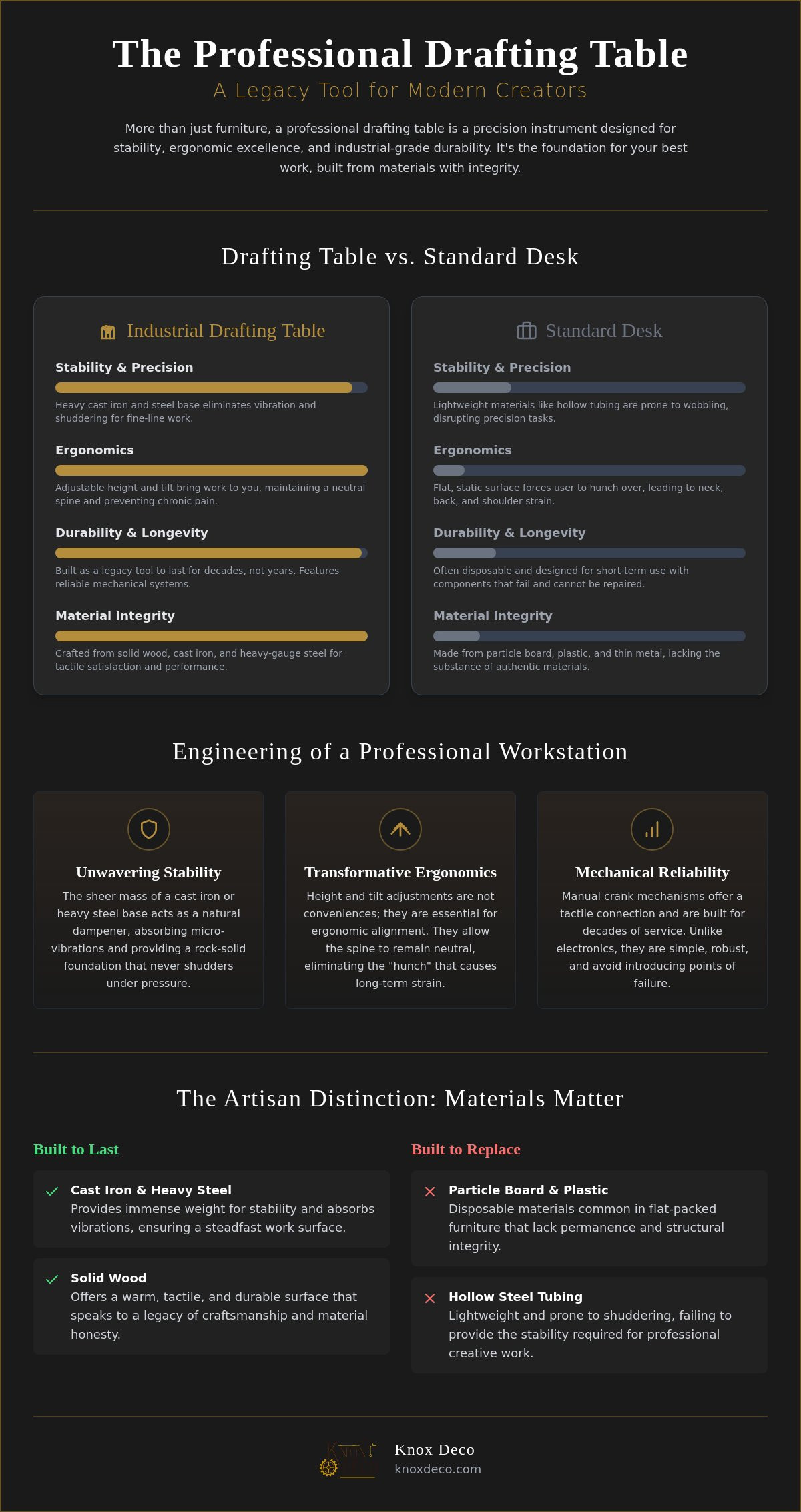
Stability is the silent partner of every great design. When you're leaning into a detailed sketch or pressing a drafting lead against a straightedge, the last thing you need is a workstation that shudders. This is where the engineering of a professional drafting table proves its worth. Unlike mass-produced desks built from hollow steel tubing or extruded aluminum, industrial-grade tables rely on the sheer mass of cast iron and heavy steel. Mass acts as a natural dampener; it absorbs the micro-vibrations that occur during high-pressure drawing. When a base lacks physical weight, it lacks the authority to remain stationary under the leverage of a tilted top.
The choice between mechanical systems and electronic motors is another defining factor in professional performance. While electric height adjustments might seem convenient, they introduce points of failure that can't be easily repaired. A manual crank mechanism is a masterclass in mechanical excellence. It offers a tactile connection to your workstation that a button simply cannot replicate. These systems are built for decades of service, ensuring that your table remains as responsive on day one as it is in year twenty. It's about choosing a tool that values longevity over temporary convenience.
The Case for Cast Iron Bases
A tilting work surface creates unique physics. As the angle increases, the center of gravity shifts, putting immense pressure on the adjustment points. Industrial-grade cast-iron bases are designed to handle this leverage without bowing or tipping. The weight distribution is intentional, keeping the bulk of the mass near the floor to anchor the entire unit. At Knox Deco, we embrace this rugged aesthetic because it serves a functional truth. A heavy base provides an unwavering foundation that allows you to focus entirely on the precision of your work rather than the stability of your furniture.
Selecting the Right Wood for Your Workspace
The work surface is where your hands spend the most time, making material choice a deeply tactile decision. Solid hardwood is the only option for a professional who demands a dent-resistant, smooth-as-glass finish. Veneers eventually peel at the edges or bubble under moisture; solid wood only gains character with age.
The finish is just as vital as the species. A high-quality sealant protects the wood from ink spills and graphite stains while maintaining the natural "feel" of the grain. You can explore our Knox Deco Custom Table Tops to see how different hardwoods can be tailored to your specific aesthetic. If you're ready to build a workstation that balances this natural beauty with structural power, we invite you to browse our collection of Writing Tables and Drafting Desks to find your perfect match.
Drafting Table vs. Standard Desk: Navigating Ergonomics and Utility
A standard desk is often little more than a static platform. It's a flat surface that demands your body conform to its limitations, forcing a fixed posture that inevitably leads to fatigue. In contrast, an industrial drafting table is a dynamic tool designed to adapt to the user. The primary distinction lies in the ability to manipulate the workspace; while a writing desk remains horizontal, a drafting workstation allows you to tilt the surface to meet your natural line of sight. This flexibility isn't just for specialized technical work. It's a fundamental shift in how you interact with your environment, turning a piece of furniture into an extension of your creative process.
Many professionals hesitate to invest in such a piece because they fear it's too specialized for everyday tasks. This is a misconception that ignores the sheer utility of a heavy-duty, adjustable surface. Modern industrial tables equipped with manual crank mechanisms offer a seamless transition between sitting and standing heights. This "sit-stand" capability, paired with the ability to lock the top at a slight angle, creates a workstation that is far more versatile than a traditional executive desk. Whether you're reviewing large-scale prints, typing on a laptop, or sketching, the ability to adjust your workstation's height and angle ensures you're never locked into a single, straining position.
The Hybrid Workflow: Analog Meet Digital
The modern creative process is rarely purely analog. Most workflows now require a harmony between digital tablets and traditional monitors. An industrial surface provides the depth and stability needed to support a dual-monitor setup while leaving ample room for a Wacom or iPad Pro. When using a tablet at an angle, the integrated pencil ledge becomes a vital feature, acting as a secure lip that prevents expensive hardware from sliding. This setup allows you to move between a vertical screen and a tilted drawing surface without ever leaving your seat. You can explore our collection of Writing Tables and Drafting Desks to see how these mechanical features integrate into a modern digital studio.
Ergonomic Advantages for the Modern Professional
Repetitive stress injuries often stem from a lack of movement. By frequently changing the angle and height of your workspace, you engage different muscle groups and reduce the pressure on your lower back. The expansive surface area of a professional table also encourages a greater range of motion, preventing the cramped feeling associated with smaller, generic office furniture. There is also a psychological benefit to the materials themselves. The "soul" of a solid wood writing desk or drafting station provides a warmth and character that inspires better work. It's a grounded, intentional choice that prioritizes your physical well-being and your creative output in equal measure.
Design Specifications: Selecting the Ideal Dimensions and Features for Your Studio
Choosing an industrial drafting table requires a shift in perspective. You aren't just buying a desk; you're integrating a structural centerpiece into your home. Before you commit to a specific model, you must account for the physical footprint of a heavy-duty base. Unlike lightweight office furniture, these cast-iron and steel foundations require a stable, level floor and enough clearance to allow for the full range of the tilting top. You should measure not only the width of your available wall space but also the depth needed when the table is fully horizontal. A piece with this much character deserves room to breathe, ensuring it remains the focal point of your creative environment.
The dimensions of the tabletop should be dictated by your specific workflow. A 60" x 36" surface offers a deep, immersive workspace that is ideal for architects or painters who need to spread out large-scale materials. In contrast, a 72" x 30" top provides a wider, more linear landscape. This longer configuration is often preferred by modern professionals who need to balance a dual-monitor setup alongside a physical sketchbook or tablet. Regardless of the size you choose, the surface should be solid hardwood to provide the necessary weight and resistance to vibration during detail-oriented tasks.
Finding the Right Height and Tilt Range
Precision is found in the mechanics. While standard desks offer a fixed height, a professional workstation utilizes an industrial crank mechanism to provide granular control over your posture. This allows you to move seamlessly from a standard sitting height to a standing position, or even a bar-height stool. For maximum versatility, look for a tilt range of 0 to 90 degrees. A slight 15-degree angle is often perfect for long-form writing, while a steeper 60-degree tilt is superior for drawing. When the table is locked at a full 90 degrees, it can even serve as a vertical display or a unique presentation board for your latest project.
Aesthetic Integration in the Modern Home
An industrial workstation is a bold statement. Its rugged nature provides a striking contrast when placed in a minimalist or contemporary room. The marriage of heavy metal and natural wood grain allows these pieces to bridge the gap between different design styles, working just as well in a rustic loft as they do in a high-end modern office. If you're interested in how these structural elements can transform other areas of your home, you might find inspiration in our Definitive Guide to Industrial Dining Tables. These pieces are designed to be legacy items that gain personality as they age. To find the foundation for your next great project, explore our handcrafted collection of Writing Tables and Drafting Desks today.
The Artisan Distinction: Why Handcrafted Industrial Furniture Outlasts Mass-Produced Alternatives
Choosing a professional drafting table is an investment in your creative heritage. There's a fundamental difference between "industrial style" and "industrial grade." While mass-produced imports often use thin metal tubing and wood veneers to mimic a look, authentic industrial-grade furniture relies on the raw honesty of heavy cast iron and solid hardwood. These materials aren't chosen for a trend; they're selected for their soul. When a piece is handcrafted in Tennessee, it carries the weight of local pride and the meticulous oversight of an artisan who understands how every gear and joint must perform under pressure.
The environmental and financial benefits of this approach are clear. Instead of participating in a cycle of disposable furniture that ends up in a landfill within a few years, you're acquiring a lifetime piece. A solid wood top can be sanded and refinished many times over the decades, allowing it to evolve with your studio. This isn't just about utility; it's about the story etched into the grain of the wood and the casting of the iron. It's a narrative of material integrity that adds tangible value to your home. A professional drafting table should be more than a surface; it should be a legacy tool that inspires your best work.
Heirloom Quality: Built to Last Generations
Mechanical excellence is the hallmark of heirloom quality. Unlike electronic circuits that eventually fail and become obsolete, the manual cranks and gears found in our workstations are built for repairability. They're designed to be understood and maintained, ensuring the table remains functional for generations. For those looking to create a cohesive professional environment, the Knox Deco Harvester Executive Desk serves as a perfect companion piece. It shares the same structural DNA as our drafting workstations, providing a unified aesthetic of strength and sophistication throughout your office.
Supporting American Craftsmanship
When you choose Knox Deco, you're supporting American craftsmanship and our deep Tennessee roots. This isn't just about local support; it's about an uncompromising commitment to quality that mass production can't touch. Every piece we build is an investment in local heritage and the enduring value of handcrafted work. We invite you to slow down and appreciate the finer details of our designs by visiting the Knox Deco homepage to explore the full collection. Discover how heavy-duty, structural design can provide the warmth and personality your modern living space deserves.
Build Your Creative Legacy on a Foundation of Strength
A workstation should be as enduring as the ideas created upon it. By choosing a professional drafting table, you're prioritizing the physical integrity of solid wood and the unwavering stability of cast iron. We've explored how precise mechanical adjustments protect your long-term posture, while the soul of handcrafted materials inspires a deeper connection to your daily work. This isn't just about furniture; it's about reclaiming a sense of permanence in a world of temporary, mass-produced solutions. You deserve a tool that responds to your touch and stands firm under the weight of your most ambitious projects.
Our pieces are handcrafted in Tennessee with a commitment to solid wood and cast iron construction that ensures lifetime durability. Every weld and grain tells a story of craftsmanship that mass production simply cannot replicate. It's time to ground your studio in a piece that balances rugged industrial power with refined, sophisticated comfort. We invite you to slow down and appreciate the mechanical excellence that only an artisan can provide.
Explore Our Handcrafted Industrial Drafting Desks
Take the first step toward a more intentional, ergonomic, and inspiring workspace today. Your best work is waiting for a foundation that is as bold and uncompromising as your own creative vision.
Frequently Asked Questions
What is the best wood for a drafting table top?
Hardwoods like Acacia are the superior choices for a professional workspace due to their density and natural resistance to dents. A solid wood surface provides the necessary mass to dampen vibrations, which is vital for precision work. Unlike veneers that eventually peel or bubble, solid wood matures with your studio and can be refinished to maintain its integrity for decades.
Can I use a drafting table as a regular computer desk?
You can absolutely use a drafting table as a standard computer desk. The adjustable tilt allows you to move from a perfectly flat surface for typing to an angled orientation for reading or drawing. This versatility makes it an ideal centerpiece for hybrid workflows where you need to balance digital monitors with traditional analog tools in a single workstation.
How much weight can an industrial drafting table support?
Industrial-grade tables built with cast iron and heavy steel are designed to support hundreds of pounds without compromising their structural integrity. This high weight capacity ensures the top won't bow or shudder under the load of multiple monitors, heavy reference books, or specialized technical equipment. The mass of the base acts as a permanent anchor for your most demanding projects.
Is a manual crank better than an electric motor for height adjustment?
A manual crank is often better for long-term reliability because it relies on robust mechanical gears rather than delicate electronic circuits. These manual systems are more repairable and offer a tactile, intentional adjustment experience that a button can't replicate. You'll never have to worry about a motor burning out or a power failure interrupting your creative momentum.
What is the standard size for a professional drafting table?
Professional sizes typically range from 60" x 36" for deep, immersive workspaces to 72" x 30" for wider, linear configurations. These dimensions provide the expansive surface area required to spread out large-scale blueprints or host a full dual-monitor setup. Selecting the right size depends on your specific creative tasks and the physical footprint available in your home or studio.
Do I need a special chair for a drafting table?
While you can use various seating, a dedicated drafting stool is the best companion for these taller workstations. Since these tables often sit higher than standard desks to accommodate standing work, a stool with an integrated footring ensures your legs are supported. This setup maintains proper ergonomic alignment and prevents strain during long hours of focused detail work.
How do I maintain and clean a solid wood industrial desk?
Clean your solid wood desk with a soft, damp cloth and a mild soap solution, making sure to avoid harsh chemicals that can strip the protective finish. Periodically applying a high-quality furniture wax helps preserve the wood's natural luster and moisture. Because the top is solid wood, you have the freedom to sand and refinish it if it sustains heavy wear over many years.
Why are industrial drafting tables so much heavier than standard desks?
Industrial tables are significantly heavier because they use solid cast iron and thick steel to prioritize stability and eliminate table wobble. Mass is the most effective way to dampen vibrations and ensure the surface remains perfectly still while you work. This intentional weight creates an anchored, unwavering foundation that lightweight, mass-produced furniture simply cannot provide.

