
Stability isn't just a physical requirement; it's the silent language of authority in a high-stakes boardroom. You've likely felt the subtle, frustrating shift of a table that moves when someone leans in, or the distracting vibration of a thin metal frame during a critical presentation. When your furniture feels temporary, it undermines the permanence of the decisions being made around it. Choosing a cast iron base conference table ensures your workspace is anchored by more than just weight. It's about a rugged confidence. It's a choice that commands respect from the moment guests enter the room.
In this guide, you'll discover why cast iron remains the engineering gold standard for supporting massive solid wood slabs. We'll explore how these bases meet rigorous ANSI/BIFMA X5.5 safety standards while providing the tactile, heirloom quality your office deserves. From mechanical excellence to the sophisticated comfort of industrial design, we're showing you how to build a table that lasts for generations.
Key Takeaways
- Understand how physical weight eliminates wobbly distractions and signals brand stability.
- Discover why the density of a cast iron base conference table offers superior vibration dampening over standard welded steel.
- Learn why it's vital to match base width to tabletop overhang to guarantee stability.
- Explore how hand-crank systems blend vintage mechanics with modern ergonomics for dynamic meetings.
Table of Contents
-
The Foundation of Authority: Why Base Stability Matters in the Conference Room
-
The Engineering Excellence of Cast Iron: Stability Beyond Standard Steel
-
Choosing the Right Base for Large-Scale Solid Wood and Epoxy Tops
-
The Knox Deco Difference: Handcrafted Cast Iron Tables Built for Generations
The Foundation of Authority: Why Base Stability Matters in the Conference Room
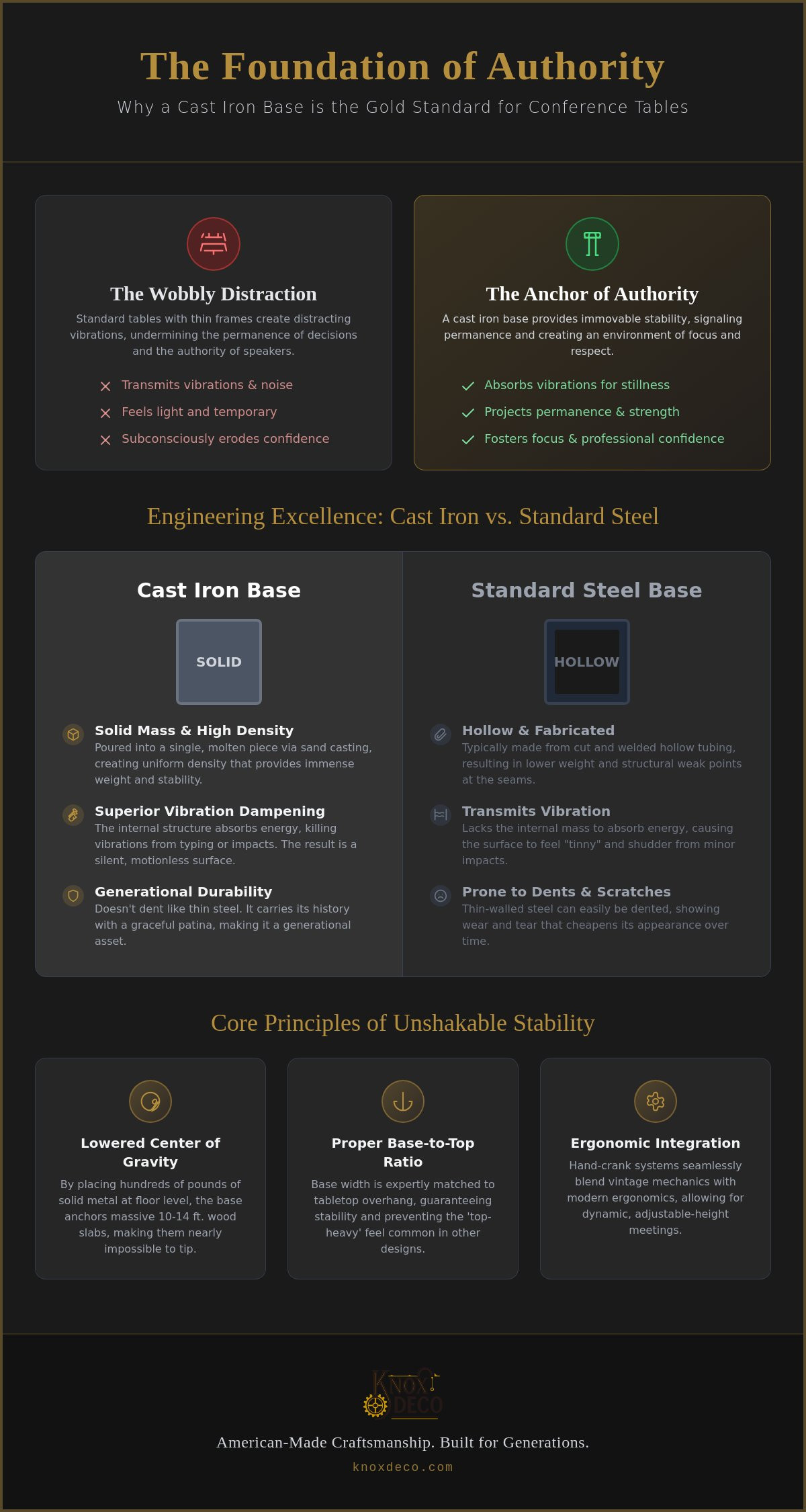
The conference table acts as the command center of the modern office. It is the literal and figurative anchor where strategy is born and partnerships are sealed. When you sit at a table that feels light or vibrates when a laptop is set down, it creates a subconscious sense of transience. A flimsy foundation suggests a flimsy organization. In contrast, heavy materials signal brand stability to every client and partner who takes a seat at one of our communal conference tables.
Beyond the visual appeal, stability is a functional requirement for any professional setting. A table that shifts during a critical negotiation doesn't just distract; it subtly erodes the speaker's authority. By choosing a cast iron base conference table, you are opting for a piece of furniture that refuses to move, providing a steady platform for high-stakes decision-making. This isn't about mere decoration. It's about engineering an environment that supports professional confidence through sheer physical presence.
The Psychological Impact of Heavy-Duty Furniture
There is a profound psychological weight to heavy-duty furniture. When executives and board members lean into a solid wood slab supported by a massive base, the lack of movement fosters a sense of focus. This "gravity" is essential in executive suites where decisions carry significant consequences. Because of the unique properties of cast iron, these bases offer a density that modern, thin-walled steel tubes simply cannot match. This density translates to a tactile experience of permanence. We've moved past the era of disposable, flat-pack office furniture. Today's leaders are looking for legacy investments that reflect the enduring nature of their companies.
Structural Integrity for Collaborative Spaces
Modern collaborative work often requires expansive surfaces, sometimes reaching lengths of 10 to 12 feet. Supporting these massive solid wood or epoxy slabs requires more than just legs; it requires a structural system. A cast iron base conference table manages this immense weight without the risk of center-sag or structural fatigue over time. To ensure total stability, the base must have a significant floor-contact surface area. This prevents the "top-heavy" feel that plagues many contemporary designs. Whether it's a 4-leg configuration or a specialized 3-legged system, the focus remains on ensuring that even when a dozen people lean on the edge of the table, the surface remains perfectly level and motionless. This mechanical excellence is what transforms a simple piece of furniture into a generational asset.
The Engineering Excellence of Cast Iron: Stability Beyond Standard Steel
Why does cast iron feel different? It is the engineering gold standard for a reason. While standard office furniture often relies on hollow steel tubing, a cast iron base conference table utilizes solid mass to anchor the room. This mass comes from the sand casting process. Unlike fabricated steel, which is cut and welded, cast iron is poured into a mold as a single, molten piece. This creates a uniform density that absorbs energy rather than reflecting it. It is the same reason heavy machinery in factories is built on cast iron frames; it kills vibration at the source.
In a meeting, this translates to silence and stillness. When someone types aggressively or sets down a heavy coffee mug, the table doesn't ring or shudder. The weight distribution is also critical. Solid wood slabs, especially those reaching 10 or 12 feet, are naturally top-heavy. By placing hundreds of pounds of solid metal at the floor level, you effectively lower the center of gravity. This makes the entire assembly nearly impossible to tip or wobble. If you are looking to upgrade your workspace, you might consider how our handcrafted conference tables leverage this mechanical integrity to create a more focused environment.
Cast Iron vs. Fabricated Steel Tubing
Hollow steel tubing feels tinny because it lacks the internal structure to dampen sound. Cast iron feels "dead" in the best possible way. It offers a structural rigidity that resists the natural tendency of live-edge or epoxy slabs to shift or bow over time. For high-traffic offices, the durability is unmatched. Our finishes protect the metal, but even if the surface is struck, cast iron doesn't dent like thin steel. It carries its history with a graceful patina rather than just showing scratches. This makes it an ideal choice for a high-end executive desk or a shared workspace where longevity is a priority.
The Science of the "Dead Weight" Base
High-mass bases are essential for maintaining an ergonomic conference room setup because they provide a perfectly level surface that doesn't oscillate during use. This prevents the micro-vibrations that can cause subtle distractions over long hours. Cast iron density in furniture engineering is the measurement of mass per unit volume that provides the necessary inertia to counteract external force and mechanical resonance. This high tensile strength allows for expansive conference spans without the need for unsightly middle support legs that clutter the floor and limit legroom. The result is a table that remains as rigid and reliable as the day it was forged.
Choosing the Right Base for Large-Scale Solid Wood and Epoxy Tops
Selecting a cast iron base conference table requires more than an eye for aesthetics; it requires a calculated approach to geometry. When dealing with a 10-foot walnut slab or a high-density resin piece, the base is the silent partner ensuring the surface remains true. You have to balance the overhang. If the base is too narrow, the table becomes a tipping hazard. If it's too wide, your guests will spend the meeting knocking their knees against the metal. We recommend a base width that leaves roughly 12 to 15 inches of clearance for legroom while maintaining a footprint large enough to meet ANSI/BIFMA X5.5-2021 stability standards. This balance ensures that the table is both a functional workspace and a safe architectural element.
The weight capacity is another non-negotiable factor. A 2-inch thick solid wood top is heavy, but an epoxy resin top of the same size can be significantly denser. Cast iron is the ideal material here because it doesn't just hold the weight; it anchors it. Whether you are using a central pedestal or a multi-leg system, the goal is to create a "dead weight" effect that prevents the table from shifting during use. This is especially important on polished concrete or hardwood floors, where a lighter table might slide. Our bases are designed to distribute this mass evenly, protecting your flooring while providing a rock-solid foundation.
Scaling for Length: From 8 Feet to 14 Feet
Long tables present a unique challenge: the see-saw effect. On extra-long Communal Tables, a standard two-leg pedestal system might allow the ends to bounce or vibrate. For anything over 10 feet, we often transition to a 3-legged Knox-style base or a reinforced 4-leg system. This follows a "Golden Ratio" for stability where the distance between the legs should be approximately 60% to 70% of the total table length. This distribution ensures that whether a person leans on the far corner or the center, the table feels like an extension of the floor itself.
Pairing with Custom Materials
Material density varies wildly between a 2-inch thick acacia top and a complex piece from our Epoxy Table Tops collection. Because epoxy is less flexible than natural timber, it requires a base that won't flex or bow under pressure. A cast iron base conference table provides the necessary rigidity to support these high-density surfaces without compromising the material integrity. Visually, the dark, textured finish of the iron offers a rugged contrast to the organic warmth of walnut, oak, or acacia, highlighting the natural character of the wood while providing an industrial edge.
The Functional Advantage: Adjustable Height and Ergonomics
The modern workspace is no longer static. It breathes and adapts to the rhythm of the team. As collaborative trends shift toward the "standing meeting," the demand for height versatility in the boardroom has reached a new peak. A cast iron base conference table equipped with a manual hand-crank system provides more than just a surface; it offers a dynamic tool for engagement. Standing intervals during long strategy sessions are proven to improve focus and reduce fatigue, transforming a standard meeting into a high-energy collaboration. This flexibility allows a single room to serve multiple roles, transitioning effortlessly from a formal sit-down presentation to a casual, standing brainstorm session.
Operating a manual crank is a visceral experience. You feel the mechanical excellence of the solid cast iron gears as they engage. Unlike electric motors that can fail or feel flimsy, these hand-cranked systems are built for longevity. They offer a range of motion that allows the table to move from a standard dining height to a counter or pub height. This makes the table ideal for diverse office events, from morning board meetings to evening social hours. The visible mechanics serve as a conversation piece, blending a "steampunk" industrial aesthetic with the refined warmth of a handcrafted workspace. If you're ready to bring this level of functional art into your office, view our industrial conference tables to find the perfect fit. (weight allowance varies for height adjustment)
Sit-to-Stand Versatility in the Boardroom
Health and productivity are deeply linked to how we move throughout the day. By integrating sit-to-stand capabilities, you invite a more active culture into the executive suite. It's about breaking the monotony of the eight-hour sit. A height-adjustable cast iron base conference table allows a team to stand up and stretch without breaking their creative flow. This versatility extends beyond the table itself. To create a cohesive and flexible environment, many designers pair these tables with our Adjustable Dining Benches. This combination ensures that the entire room can rise and fall in harmony with the needs of the project.
The Aesthetic of Motion
There is a specific beauty in visible engineering. In high-end industrial design, manual cranks outperform electric motors because they celebrate the "soul" of the machine. The heavy-duty mechanical system is an intentional design choice that rejects the sterile nature of mass-produced plastic furniture. It’s a sensory experience; the weight of the iron and the smooth rotation of the handle suggest a connection to heritage and craftsmanship. When paired with industrial seating, the result is a cohesive look that feels grounded and permanent. These tables don't just occupy space. They define it through the harmony of heavy, structural components and the fluid motion of modern ergonomics.
The Knox Deco Difference: Handcrafted Cast Iron Tables Built for Generations
Knox Deco was founded on the belief that a workspace should reflect the strength of the people within it. From our origins in a tradition of meticulous craftsmanship, every cast iron base conference table is handcrafted with a deliberate focus on material integrity. We don't use thin, mass-produced components. Instead, we utilize heavy 14-gauge steel and solid cast iron mechanical systems that provide the stability discussed throughout this guide. This commitment to quality ensures that your table isn't just a purchase; it's a generational investment. Whether you're selecting a specific wood species or a custom finish, our process allows you to tailor every detail to match your brand's unique identity.
Every piece we forge is a testament to the "rugged yet refined" aesthetic that defines our brand. We understand that a conference table is the heart of your professional operations. It needs to be as resilient as your business. By choosing materials that offer natural vibration dampening and immense weight, we eliminate the distractions of lesser furniture. This is about creating a space where the physical environment supports the mental work of leadership. It's about furniture that doesn't just occupy a room but commands it.
Rugged Meets Refined: The Knox Aesthetic
Our designs bridge the gap between raw industrial grit and the sophisticated comfort of an executive suite. We draw inspiration from the American Industrial Revolution, an era defined by mechanical excellence and uncompromising durability. This history is visible in every gear and crank. It's a story of progress and permanence. You can learn more about our journey and our commitment to American craftsmanship on our About Us page. By marrying these heavy, structural components with the natural textures of solid wood, we create a piece of furniture that feels both authoritative and welcoming.
Investing in Longevity
The true return on investment for a high-end conference table isn't found in the first year; it's found in the twentieth. While cheaper alternatives vibrate and wear down, a Knox Deco table outlasts multiple office renovations. It's furniture built for the long haul. We support our clients with a commitment to national quality standards, ensuring that every piece arrives ready to anchor your workspace. From the precision of the hand-crank to the dense weight of the base, every element is designed to provide stability. If you're ready to move beyond temporary solutions and invest in a piece that truly anchors your office, we invite you to explore our collection of Industrial Conference Tables.
Anchor Your Ambition with Timeless Stability
Your conference room is where the future of your company is forged. By choosing a cast iron base conference table, you aren't just buying furniture; you're anchoring your brand with a foundation of stability and mechanical excellence. We've explored how the density of cast iron dampens vibration and how adjustable height systems bring modern ergonomics to the executive suite. These aren't temporary fixtures. They are handcrafted legacy pieces built to survive office renovations and shifting trends.
Every table draws from Industrial inspiration, utilizing heavy-duty 14-gauge steel and solid cast iron to ensure a lifetime of service. We stand behind our craftsmanship with a 30-Day Refund Policy and offer national shipping across the mainland United States to bring this rugged sophistication to your door. It's time to move past thin metal and hollow frames. Command your workspace with a handcrafted Knox Deco Conference Table and feel the difference that material integrity makes. Your team deserves a space that reflects their strength and ambition.
Frequently Asked Questions
How much weight can a cast iron conference table base actually support?
A standard cast iron base conference table system is engineered to support several hundred pounds of solid material with ease. These bases manage the significant mass of solid acacia or walnut epoxy resin tops without structural fatigue. Because we use solid cast iron and heavy-gauge steel, the weight capacity often exceeds the requirements of even the heaviest custom slabs.
Is a cast iron base too heavy for standard office building floors?
Most modern office buildings are designed to handle the weight of heavy-duty furniture without any structural modifications. While the table itself is substantial, the weight is distributed across a wide floor-contact surface area. If you're placing a 10-foot or 12-foot table on a standard commercial floor, the load per square foot remains well within typical safety margins.
What is the difference between a cast iron base and a fabricated steel base?
Cast iron is poured as a single molten piece; fabricated steel is usually welded from hollow tubes. This difference in manufacturing gives cast iron a much higher density. This density kills vibrations and provides a "dead weight" feel that hollow steel cannot replicate. It creates a more stable, vibration-free platform that is essential for high-stakes professional environments.
Can I use an adjustable height crank table as a permanent standing desk?
Yes, our hand-crank tables are perfectly suited for use as permanent standing desks or collaborative hubs. The mechanical excellence of the solid gears ensures that the table remains rigid at any height. Unlike electric motors that can burn out over time, a manual crank provides a reliable, lifetime solution for sit-to-stand versatility in a busy office.
How do I maintain the finish on a cast iron table base?
Maintenance is simple because we use high-quality finishes on our metal components. You can keep the base looking pristine by wiping it down with a soft, damp cloth to remove dust. Because cast iron is exceptionally durable, it doesn't dent or scratch as easily as thin-walled metal. It carries its history with a graceful patina rather than showing wear. For gear use, cranking periodically and using a lubricant will help the gears from drying and being difficult to adjust.
What size cast iron base do I need for a 12-foot conference table?
For a 10-foot table, you generally need a base system that spans approximately 6 to 7 feet in length. This follows the rule of thumb that the base should cover 60% to 70% of the total tabletop length. Using a 3-legged Knox-style system or two large pedestals ensures that the ends of the cast iron base conference table don't bounce when someone leans on them.
Do cast iron bases require special assembly or professional installation?
We recommend professional installation or a team of at least three people due to the sheer weight of the components. While the assembly process itself is straightforward and methodical, the physical mass of the iron requires careful handling. Proper setup ensures that the table is perfectly leveled and anchored for decades of reliable use in your command center. We would be happy to provide a quote for white glove service.
Can cast iron bases be used with epoxy resin or glass tabletops?
Cast iron bases are an ideal choice for epoxy resin tops because they provide the absolute rigidity these high-density materials require. While they can support glass, they are most frequently paired with solid wood or epoxy to highlight the rugged contrast between natural textures and industrial metal. The solid foundation prevents the micro-shifts that could stress custom-poured resin surfaces.

